Martin Luther, writing in his Large Catechism, pointed to the Ten Commandments, the Articles of Faith (Apostle’s Creed), and the Lord’s Prayer (the “Our Father”), describing them as follows:
15]These are the most necessary parts which one should first learn to repeat word for word, 16] and which our children should be accustomed to recite daily when they arise in the morning, when they sit down to their meals, and when they retire at night; and until they repeat them, they should be given neither food nor drink.
Likewise, servants in one’s household should be held to the same requirement to learn and be able to recite these basics of the Christian faith.
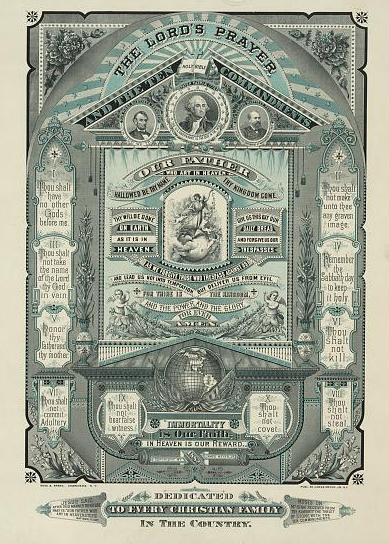
Having done so, each one should understand and be able…
also to know what to say concerning our Sacraments, which Christ Himself instituted, Baptism and the holy body and blood of Christ… (Matthew 28:19 and Mark 16:15).
Luther went on to explain the meaning and application of each of the ‘necessary parts’, starting with the First Commandment, “You shall have no other gods.”
Whereas, in his Small Catechism he summarizes his answer to the question “What does this mean?” with the following 11 words: “We should fear, love and trust in God above all things,” in the Large Catechism, he devoted more than 3,000 words.
Luther believed the proper teaching method was to begin with teaching the texts so that students memorized them completely. In his preface to the Small Catechism (p. 248), Luther makes very clear that the young need to memorize and recite the catechism word for word and to be told that failure to do so is a denial of Christ.
After having memorized the Ten Commandments, the Creed and the Lord’s Prayer and reciting them word for word, they should be taught the meanings also through the shorter, Small Catechism. Thirdly, he said (p. 249):
…take up the Large Catechism and give them also a richer and fuller knowledge…. Enlarge upon every commandment… with its various works, uses, benefits, dangers, and injuries… urge the commandment or part that most suffers the greatest neglect among your people.
 Faith Lutheran Church Warsaw, MO - LCMS